BETA Feed Awareness Week flies the flag for equine nutrition

BETA Feed Awareness Week is back – running for a third time – earlier in the year than usual, but with the same mission, to dispel feeding myths and grow nutritional knowledge. This popular campaign will take place from 27 March to 4 April, just as spring arrives and the competition season begins to unfold.


The initiative, designed to help sort feeding fact from fiction, will reach out to the nation’s horse owners and carers with a huge helping of trustworthy tips and guidance from qualified equine nutritionists.
Many BETA retail and trade members will participate, promoting Feed Awareness Week both in-store, online and via social media, where they will fly the flag for the campaign and its key messages about equine nutritional wellbeing.

A full list of those taking part can be found on the BETA website, beta-uk.org.
The week is supported by leading equestrian organisations such as the British Horse Society, the Pony Club, British Eventing, British Riding Clubs and The Great Horses for Health UK Relay, as well as some of the sport’s most famous competition riders.


“We are delighted to welcome this important campaign back once again following a challenging year that resulted in its postponement in 2020,” said BETA executive director Claire Williams. “With a worrying rise in unqualified or would-be nutritionists on social media, it is essential that owners are able to source sound, professional advice. Feed Awareness Week ticks all the boxes and ensures that trustworthy nutritional information is easily accessible for all. The information provided will help develop existing knowledge and what is learned will remain with people for life.”


Consumers are invited to follow and engage with Feed Awareness Week on Facebook or Instagram using the #BFAW21 hashtag. A flurry of exciting activity will begin two weeks before the actual event, with a series of competitions to win prizes such as saddlecloths and goody bags.

Finalists announced for two leading 2021 BETA Business Awards


Finalists of the SEIB Retailer of the Year and STUBBS ENGLAND Nutritional Helpline of the Year – categories in the 2021 BETA Business Awards – have been announced. Shortlists were drawn up following a nomination period in which consumers put forward retailers and feed company nutrition teams they felt had gone above and beyond to provide excellent customer service.


The SEIB Retailer of the Year award, aimed at tack shops and feed merchants, whether or not they are BETA members, is divided into two sections – Equestrian Retail Store and Online/Mail Order Retailer.

Equestrian Retail Store finalists are:
• RB Equestrian, Milton Keynes, Buckinghamshire.
• The Millwheel Tack Shop and GG Feeds, Warfield, Berkshire.
• The Tack Room Milnathort, Kinross.
• 1st Choice Horse Supplies, Larkhall, South Lanarkshire.
• Redpost Equestrian, Totnes, Devon.
• Barnyard Pet & Equestrian Supplies, Northwich, Cheshire.

Online/Mail Order Retailer finalists are:

  • GS Equestrian, Paignton, Devon.
  • Redpost Equestrian, Totnes, Devon.
  • Urban Horse, Alston, Cumbria.
  • RB Equestrian, Milton Keynes, Buckinghamshire.
  • Online for Equine/Highfield Equestrian, Shirleywich, Staffordshire.
  • Equus England, Stevenage, Hertfordshire.


The STUBBS ENGLAND Nutritional Helpline of the Year award is presented to a feed company nutrition team considered to offer excellence in advice and support to customers. The finalists are:
• Science Supplements, Hartwell, Northamptonshire.
• TopSpec Equine, Thirsk, North Yorkshire.
• Baileys Horse Feeds, Braintree, Essex.
• Spillers, Milton Keynes, Buckinghamshire.
• Dengie Horse Feeds, Maldon, Essex.
• Simple System Horse Feeds, Bury St Edmunds, Suffolk.


“We would like to congratulate these finalists and wish them the very best of luck,” said BETA executive director Claire Williams. “They have all done incredibly well to get this far. The past year has been a challenging time for us all and they have worked extremely hard to support customers and horse owners with a steady and constant supply of everyday essentials, expert advice and high levels of service. I am delighted that the awards will show our appreciation for their efforts and celebrate those that have made outstanding contributions to the equestrian industry.”


Winners of the SEIB Retailer of the Year and the STUBBS ENGLAND Nutritional Helpline of the Year awards will be announced, along with the rest of the 2021 BETA Business Awards, in an online ceremony at 4pm on Thursday 11 March. Further details are available from the BETA office, telephone 01937 587062 or email agy@beta-uk.org.

Search under way for winner of the 2021 BETA Equine Thesis of the Year Award

The search is on for the winner of the Equine Thesis of the Year Award, BETA’s annual initiative to recognise academic excellence in undergraduate equine-related study. Universities and colleges across the UK and Ireland offering appropriate courses have each been invited to submit one student thesis into the running.


There have been 10 entries to date, from University Centre Reaseheath, Writtle University College, Harper Adams University, Duchy College, Warwickshire College, Royal Veterinary College, University Centre Myerscough, University of Limerick, Bishop Burton College and University Centre Sparsholt. Further submissions are expected before the 9 July deadline.


All entered theses will then be put through an independent preliminary judging round, with shortlisted students called to present their work to a panel of equestrian experts chaired by Dr Georgina Crossman during a virtual finals and awards ceremony on Sunday 31 October. The winner will receive a cash prize and trophy.


“The awards are a fantastic showcase for undergraduate study,” said BETA executive director Claire Williams. “Since BETA reintroduced them in 2016, they have continued to grow in both popularity and stature. A win in these prestigious awards is certainly something to write home about and a tremendous asset to add to students’ CVs as they embark on their chosen careers.
“We are really looking forward to finding out what subjects have been covered this year – and seeing how students approached and interpreted their findings.”


Last year, there were joint winners for the first time – Victoria O’Hara, of the Royal Veterinary College, and her thesis, “Use of commercial ELISA for deduction of myostatin protein in equine serum and the examination of an MSTN gene promoter SINE insertion mutation in vivo”, and Daniela Amiouny, of Aberystwyth University, with “The effects of night light and bedding depth on equine sleep and memory consolidation”.

Finalists announced for the 2021 BETA Equine Thesis of the Year Award

The search for the winner of the BETA Equine Thesis of the Year Award, which recognises and rewards excellence in undergraduate study, is almost over. Four finalists are now in the running and will present their thesis to a panel of judges during an online event on Sunday 31 October.

Universities and colleges offering equine-related degrees throughout the UK and Ireland were each invited to submit one entry, with the following making it through to the finals:
● Writtle University College – Isabelle Anderson. Thesis: Owner satisfaction with rehabilitation practices for chronic sacroiliac pain in equines in the UK since the year 2000.
● Harper Adams University – Isabel Badham. Thesis: The effect of different water depths on the activity of the equine longissimus dorsi muscle whilst walking on a water treadmill, measured by surface EMG.
● The Royal Veterinary College – Sophie Avery. Thesis: Risk factors for equine glandular disease associated with general management and husbandry of domesticated horses: A multicentre retrospective case-control study.
● University of Limerick – Rebecca Dillon. Thesis: An evaluation of racehorse performance using the speed gene test and the dosage system.
The BETA Equine Thesis of the Year finals will start at 2pm and are open to both the public and members of the academic community. Tickets are available free from Eventbrite, at

https://www.eventbrite.co.uk/e/184592971547

Each finalist will present her work and, while it is being considered by the judges, will take the opportunity to respond to questions from the audience. The judges will then return to announce the winner and runner-up of the award.

“The Equine Thesis of the Year Award is a fantastic way for us to mark the extremely high standard of undergraduate study that is being produced at our universities and colleges,” said BETA executive director Claire Williams. “There is some incredibly impressive research taking place and some exciting and diverse ideas, which will certainly give our industry – and equestrians – plenty of food for thought.


“Taking a ringside seat makes sure we can hear about the work that is being done – straight from the horse’s mouth. And maintaining the event online makes it accessible to everyone. We are really looking forward to finding out more about the theses and discovering who is crowned winner. We wish the students and their universities the very best of luck and congratulate them on making it this far.”

This year’s final judges are:
• Dr Georgina Crossman – a research consultant and owner of GK Crossman Consultancy. Georgina is a guest lecturer at various institutions, speaking on subjects such as the structure of the horse sector and the relationship between the horse industry and government.
• Katie Williams – an equine nutritionist with 20 years’ experience. She gained a master’s degree in equine science from Writtle College and received the Edgar Pye Scholarship for her dissertation on the effects of prebiotics on racehorses in training. In 2017, Katie embarked on her PhD in veterinary medicine research at the University of Glasgow. As technical and product development manager at Dengie, she is responsible for creating new products and ensuring they are legally compliant. Katie also sits on the BETA Feed Committee, provides technical support for key customers and works with the Queen’s studs at Sandringham and Balmoral.
• Karen Coumbe – a vet for more than 30 years who began her career in a mixed practice, then in 1989 co-founded a specialist equine practice, Bell Equine, in Kent, which developed into a 17-vet equine hospital approved by the Royal College of Veterinary Surgeons. Karen has been a partner since 1995 and became a director in 2012. She has a particular interest in equine anaesthesia and pain management, as well as sports medicine and equine performance, pre-purchase exams, ophthalmology, dermatology and ultrasonography. She writes veterinary books and is a regular contributor to magazines such as Horse & Hound.
• Liz Benwell – editor of leading trade title Equestrian Trade News. Liz began her career in journalism as a newspaper reporter, was the first editor of Your Horse magazine and is a self-confessed horsey “anorak”. She has enjoyed competing in many equestrian sports at amateur level, with long-distance riding a particular favourite, has three horses, all of which are rehomed from World Horse Welfare, and rides most days.

Equine Thesis of the Year 2022

Have you got the student? We’ve got the award. Does one of your students deserve special recognition?  If so, why not enter them for the BETA Equine Thesis of the Year Award.

Our search for 2022 winner of Equine Thesis has just started. The competition is open to every university and college in the UK and Republic of Ireland that has students focusing on equine and equestrian related studies.

Last year’s virtual final was a real success with large numbers viewing. This year we plan to keep the virtual element although should circumstances allow we might also return to face-to-face presentations.

A shortlist of students will present their thesis to a panel of judges and an audience of industry-based professionals on Sunday 30th October 2022. Once again, the winner will be presented with a monetary prize and trophy.

The BETA Equine Thesis of the Year Award not only demonstrates the quality of the UK and Ireland’s equine students but all the hard work that the colleges and universities put in to educate such students.   

The 2021 Equine Thesis of the Year Award was claimed by –– Isabelle Anderson of the Writtle University College with her thesis: Owner satisfaction with rehabilitation practices for chronic sacroiliac pain in equines in the UK since the year 2000.

Please contact Agy Mossakowska agy@beta-uk.org if you think you will be making an entry. The deadline for entries is Monday 6th June 2022.

Finalists announced for the 2022 BETA Equine Thesis of the Year Award

The search for the winner of the BETA Equine Thesis of the Year Award, which recognises and rewards excellence in undergraduate study, is almost over. Four finalists are now in the running and will present their thesis to a panel of judges during an online event on Sunday 30 October.

Universities and colleges offering equine-related degrees throughout the UK and Ireland were each invited to submit one entry, with the following making it through to the finals:


● Bishop Burton College – Olivia Hammond.  Thesis: The effect of the German string training aid on equine stride length, tracking distance and head and neck position.
● Harper Adams University – Jenny Johnson. Thesis: The effect of kinesio tape on the surface temperature of the forelimb superficial digital flexor tendon of polo ponies when applied beneath polo bandages during exercise.
● Hartpury University – Lizzie Millington. The immediate effects of an equine physiotherapy intervention on spinal kinematics.
● University of Limerick – Danielle Mullin. Thesis: An analysis of Dystocia in thoroughbred mares in Ireland.

The BETA Equine Thesis of the Year finals will start at 2pm and are open to both the public, trade and members of the academic community. Please register your interest to attend using the following registration form: Registration form

Each finalist will present her work and while it is being considered by the judges, will take the opportunity to respond to questions from the audience. The judges will then return to announce the winner of the award.

“The Equine Thesis of the Year Award is a fantastic way for us to mark the extremely high standard of undergraduate study that is being produced at our universities and colleges,” said BETA executive director Claire Williams. “There is some incredibly impressive research taking place and some exciting and diverse ideas, which will certainly give our industry – and equestrians – plenty of food for thought.


“Taking a ringside seat makes sure we can hear about the work that is being done – straight from the horse’s mouth. And maintaining the event online makes it accessible to everyone. We are really looking forward to finding out more about the theses and discovering who is crowned winner. We wish the students and their universities the very best of luck and congratulate them on making it this far.”

This year’s final judges are:


• Dr Georgina Crossman – a research consultant and owner of GK Crossman Consultancy. Georgina works with a number of organisations, including The Horse Trust, World Horse Welfare and Redwings Horse Sanctuary. She has also guest lectured at various institutions, including L’Institut Agro Dijon (France), speaking on subjects such as the structure of the horse sector and the relationship between the horse industry and government.


• Katie Williams – an equine nutritionist with 25 years’ experience. She gained a master’s degree in equine science from Writtle College and received the Edgar Pye Scholarship for her dissertation on the effects of prebiotics on racehorses in training. In 2017, Katie embarked on her PhD in veterinary medicine research at the University of Glasgow. As technical and product development manager at Dengie, she is responsible for creating new products and ensuring they are legally compliant. Katie also sits on the BETA Feed Committee, provides technical support for key customers and works with the Queen’s Royal studs at Sandringham and Balmoral.


• Karen Coumbe – a vet for more than 35 years who began her career in a mixed practice, after studying at Girton College, Cambridge.  Then, in 1989, she co-founded a specialist equine practice, Bell Equine, in Kent, which has developed into a nearly 30 vet equine hospital rated as outstanding at the most recent inspection by the Royal College of Veterinary Surgeons . Karen was a partner from 1995 and became a director in 2012 until the business was sold to CVS(UK)Ltd in 2017. She has a particular interest in equine anaesthesia and pain management, as well as sports medicine and equine performance, pre-purchase exams, ophthalmology, dermatology and ultrasonography. She has written veterinary books and acts as the veterinary correspondent for Horse & Hound. She also enjoys working as an official veterinarian for the FEI, even though this and her other activities interrupt work in her veggie garden and enjoying time with her own horse and two daughters.

• Liz Benwell – editor of leading trade title Equestrian Trade News. Liz began her career in journalism as a newspaper reporter, was the first editor of Your Horse magazine and is a self-confessed horsey “anorak”. She has enjoyed competing in many equestrian sports at amateur level, with long-distance riding a particular favourite, has three horses, all of which are rehomed from World Horse Welfare, and rides most days.

TOTY 2022 Final results

STUDENT’S STUDY SCOOPS TOP AWARD

Research on foaling risks and training aids impresses the judges.

Danielle Mullin is the winner of the 2022 BETA (British Equestrian Trade Association) Equine Thesis of the Year Award.

The University of Limerick equine science graduate analysed thousands of difficult births during a decade of foalings at two Thoroughbred studs in Ireland.

Danielle was presented with a trophy and £200 cash prize after four finalists had presented their theses to a panel of judges during an online event on Sunday, 30 October.

A highly commended award went to Olivia Hammond who graduated in equine therapy and rehabilitation from Bishop Burton University Centre. Olivia studied the effect of a training aid on horses’ striding and head and neck position.

Since finishing their studies, of which their award-winning theses were part, Danielle is working for a Thoroughbred stud, while Yorkshire based Olivia is a self-employed equine practitioner.


“Bringing research to life”

The judges praised all four 2022 BETA Thesis of the Year finalists’ dedication to their studies during a testing time.

“We congratulate each of the finalists on the completion of their degree and dissertation whilst challenged by the Covid-19 pandemic,” said Georgina Crossman who headed the four-strong judging panel.

“Their presentations expanded on their written dissertations, bringing their research to life.  

“Olivia Hammond showed an in-depth understanding of her research throughout her presentation.  

“Danielle Mullin’s dissertation highlighted an issue within Thoroughbred breeding that should be a concern for all breeders, while her presentation built on this and underlined the risks of breeding from any mare.”

This is the seventh year BETA has run the competition which recognises the best in undergraduate study across the UK and Ireland. An audience from the public, industry and academia watched the finalists’ presentations online.

Universities and colleges offering equine-related degrees are each invited to submit one undergraduate dissertation entry for the annual BETA Equine Thesis of the Year.

Following preliminary judging, the following made it through to Sunday’s final:

● Bishop Burton University Centre – Olivia Hammond.  Thesis: The effect of the German string training aid on equine stride length, tracking distance and head and neck position.
● Harper Adams University – Jenny Johnson. Thesis: The effect of kinesio tape on the surface temperature of the forelimb superficial digital flexor tendon of polo ponies when applied beneath polo bandages during exercise.
● Hartpury University – Lizzie Millington. Thesis: The immediate effects of an equine physiotherapy intervention on spinal kinematics.
● University of Limerick – Danielle Mullin. Thesis: An analysis of Dystocia in Thoroughbred mares in Ireland.

The judges were Dr Georgina Crossman – a research consultant and owner of GK Crossman Consultancy; Katie Williams – the technical and product development manager at Dengie; Karen Coumbe – a vet for more than 35 years and co-founder of Bell Equine in Kent; and Liz Benwell – editor of Equestrian Trade News.

Riding Simulator

Riding Simulator

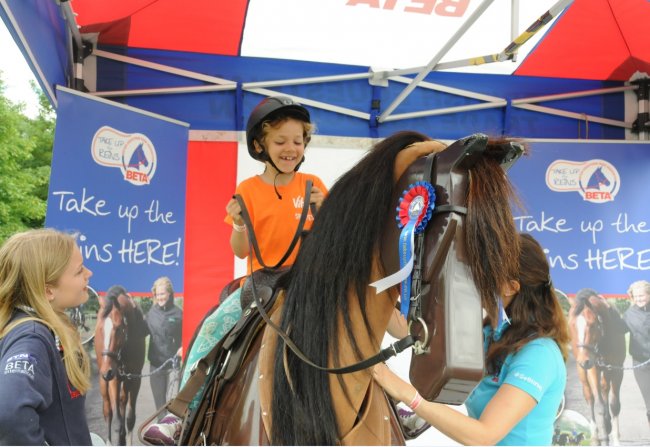
Look out for BETA RoboCob, Duke and Duchess our life-sized mechanical horses, at events across the country. The computer driven riding simulators respond to the rider’s leg and hand aids. RoboCob has five ‘gears’ – walk to gallop and Duke and Duchess have 3 speeds of canter.

Weighing in at 400kg and equipped with a conventional or western saddle and bridle, they can offer new riders a feel for the real thing, novices their first taste of trot or canter, while experienced equestrians can hone their skills.

To be found at shows and family activity events, they always arrive in style in their very own BETA-branded trailers.

The horses can be hired by both members and non-members alike. They are great at shows and events, both horsey and non. They are a real draw and can be ridden like a real horse, with the rider able, if confident, to control the pace of the horse. Their speeds are controlled by either sensor pads on both sides of the horse, or by an operator on the ground. They do not buck, or kick and are great to give nervous riders confidence, or give those who have never been on a horse, their first taste.

Robocob is 15.2 hands and takes an extra wide saddle, though he comes equipped with his own made to measure saddle and a complete set of hats.

Duke and Duchess are also 15.2hh but only has 3 paces of canter. They also come with their own saddles and supply of hats.

To enquire further about hiring either horse, download an enquiry form.

BETA-UK British Equestrian Trade Association
Privacy Overview

This website uses cookies so that we can provide you with the best user experience possible. Cookie information is stored in your browser and performs functions such as recognising you when you return to our website and helping our team to understand which sections of the website you find most interesting and useful.